
Draconian in Buenos Aires: liturgy in penumbra
The night in Flores carried something of a contained ceremony. Outside, the city followed its usual Sunday rhythm; inside, the Teatro Flores was preparing for a different tempo, slower, denser, almost detached from time. It was not just another show in the metal calendar: there was a particular, almost reverential expectation, marked by the exceptional nature of the visit and by a type of music that does not tolerate distractions.
The threshold: Emma Ruth Rundle
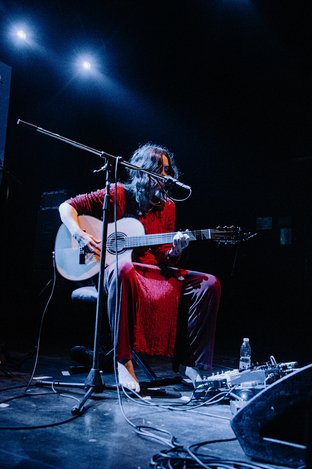
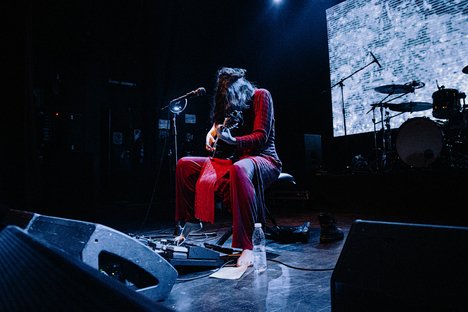
Emma Ruth Rundle took the stage with an economy of resources that, far from diminishing the experience, made it more intense. Her proposal did not seek to win over the audience; it confronted them calmly, from an intimate, almost confessional register. The sound—deep, austere—unfolded with a delicacyrarely found in an act preceding a heavier headliner.
Far from being a functional opening, hers was a space of its own. The songs developed like small, self-contained fragments of an emotional universe that demanded full attention.
The audience, far from the impatience that often accompanies these early segments, responded with active listening: silences respected, extended applause, a devotion closer, to contemplation than to effusiveness.
Rundle expressed gratitude repeatedly. There was something of genuine surprise in her demeanor, as if the format—intimate, concentrated—and the audience’s reception restored a particular dimension to her music. In that context, Teatro Flores seemed to adapt to her atmosphere, as though the venue itself understood that the role of opener could, at times, dissolve into something more significant.
The emergence: Draconian
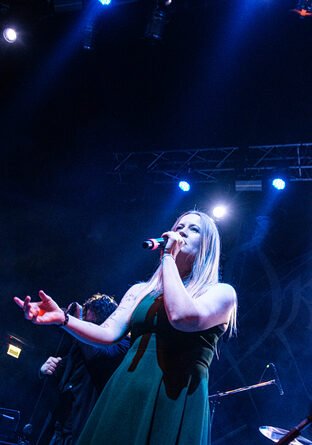
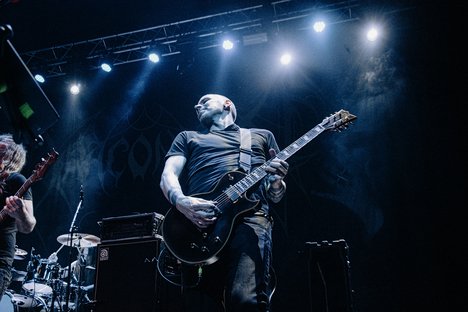
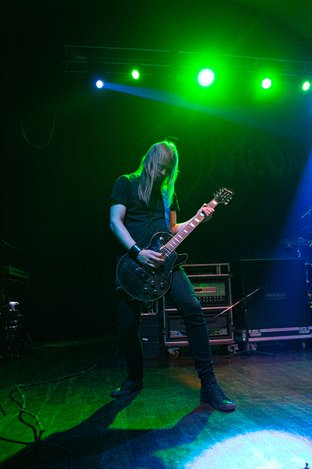
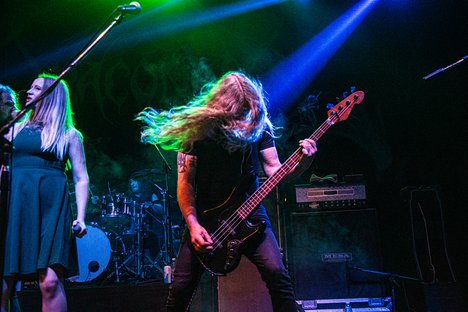
The shift in dynamics was not abrupt, but it was decisive. When Draconian took the stage, the atmosphere built by Rundle mutated into a more corporeal, heavier density, without losing emotional continuity. There was no rupture: there was transition.
From the opening passages, it became clear that the band had come to deliver exactly what their audience expected, though that did not make the result predictable. Their set moved between emblematic pieces and more recent material, with a marked presence of their latest work In Somnolent Ruin. It was in that intersection between past and present that the heart of the concert was structured.
The body of the show
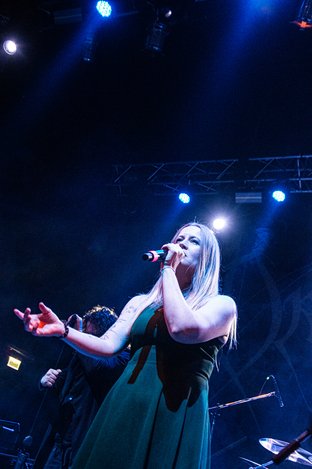
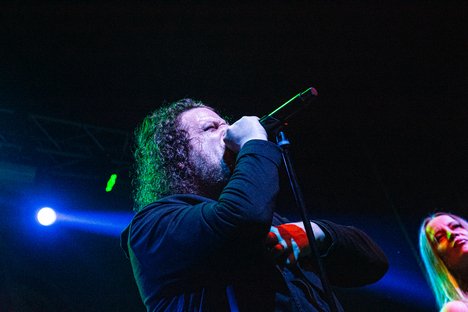
Draconian’s sound does not rely on urgency, but on persistence. The songs advanced like compact blocks, with prolonged tempos and layered structures. Within that framework, the dual vocal approach once again became the central expressive axis.
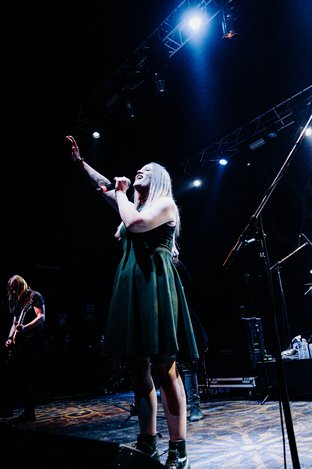
Lisa Johansson and Anders Jacobsson delivered a solid performance, without excess. Johansson’s voice, in particular, carried that melancholic edge that does not seek to dominate, but to permeate. Jacobsson, for his part, sustained the contrast with a firm presence, avoiding the kind of guttural caricature that can sometimes distort the genre.
There was no overacting: there was control.
The audience responded from a contained place, aligned with the proposal. This was not a concert of release, but of absorption. Listening was a constitutive part of the experience.
The point of gravity
Within the set, The Face of God functioned as a point of gravity. There, all elements converged with greater clarity: the tension between the ethereal and the visceral, the slow-building dynamic that accumulates weight rather than releasing it suddenly, and a particularly focused vocal performance.
It was the moment when the band seemed to find its clearest point of connection with the room. Not in terms of immediate reaction, but in that kind of silent synchrony where band and audience appear to share the same pulse.
The close: persistences
The ending did not seek a grand resolution. Draconian left the stage without fully breaking the atmosphere they had constructed, as if understanding that their music does not allow for closed endings. What remained was a suspended sensation, a kind of echo that does not entirely dissipate when the lights come up.
In retrospect, the night functioned more as an accumulative experience than as a sequence of highlighted moments. Emma Ruth Rundle offered a precise entry point, without concessions. Draconian, in turn, sustained a recognizable identity, faithful to their essence, avoiding unnecessary artifice.
It was not a show of immediate impact or effect driven gestures. It was, rather, a coherent exposition of a language that continues to find in slowness, density, and contrast its most effective tools. In times where the ephemeral tends to prevail, proposals like this demand another kind of presence: more attentive, more patient.
And that night, in Flores, there was an audience ready for it.
Review by Gustavo Osorio
Photos Ivy Llad
Produced by NWM Productions
Press Gaby Sisti